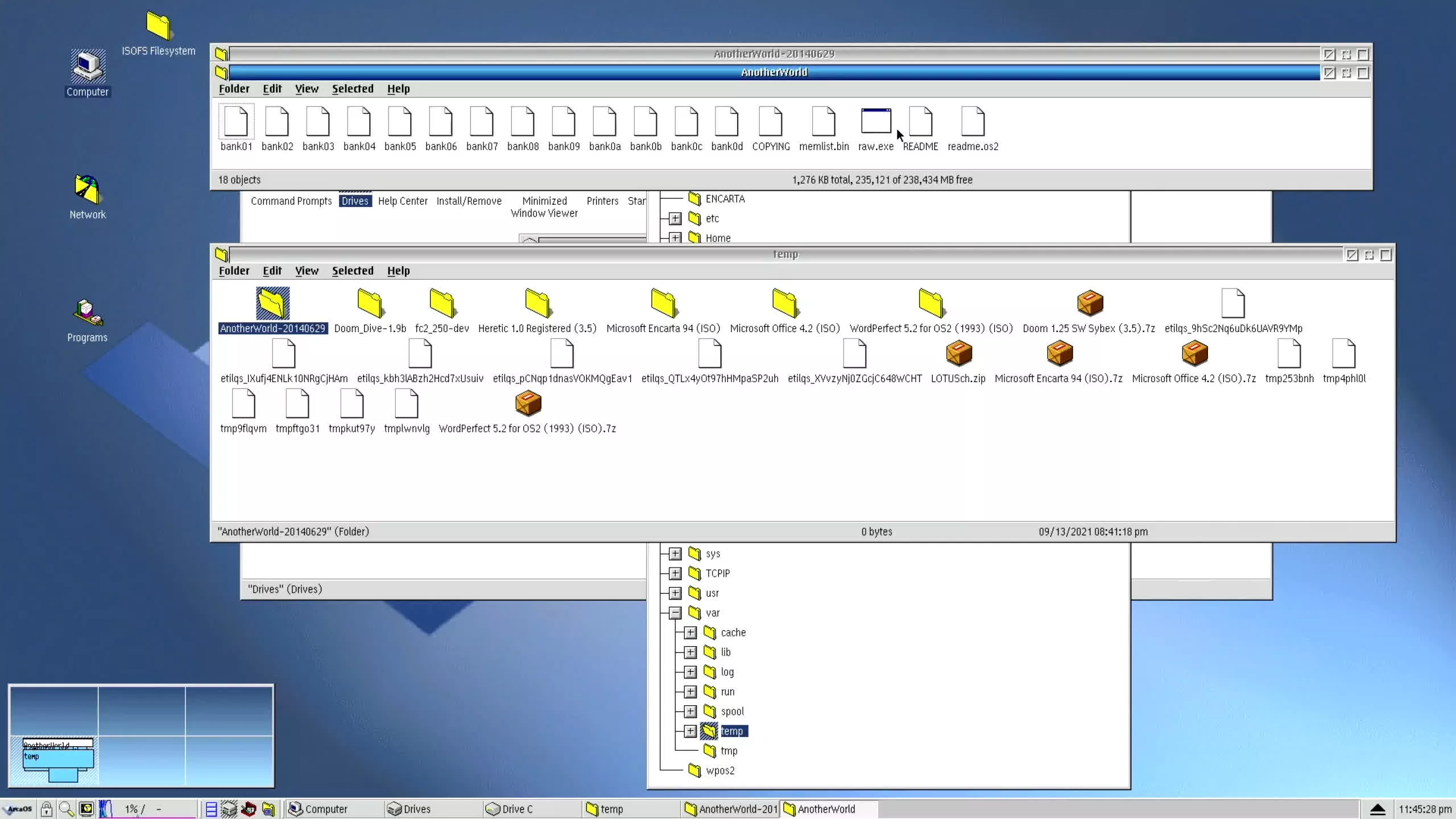
TL;DR: IBM's involvement in OS/2 development ended long ago, but the ancient platform is still being sold by third-party venture Arca Noae LLC. The company regularly updates its ArcaOS offering to fix bugs and improve compatibility with modern machines.
A quarter of a century after IBM released the last official version of OS/2, someone is still keeping the platform alive under the ArcaOS name. Arca Noae is now the only company licensing OS/2 technology from IBM, after Serenity Systems' eComStation project disappeared around 14 years ago.
Arca Noae recently announced a brand-new release of ArcaOS, a 32-bit operating system based on OS/2 Warp 4.52. First and foremost, ArcaOS 5.1.2 provides better compatibility with the latest UEFI-based x86 systems. The operating system should now be easier to install on modern computers, even when they use the GUID Partition Table standard instead of traditional MBR-style partitioning.
At the same time, Arca Noae said that ArcaOS 5.1.2 can still boot, install, and run on older BIOS-based systems, delivering the same improvements in stability and performance. The new release also includes updates to the desktop experience, many system drivers, localizations, the pre-boot environment, and more. A new ArcaOS license costs $139, and Arca Noae also offers discount programs for existing customers whose support plans have expired.
Speaking about customers, Arca Noae describes ArcaOS as a good operating system for professionals still clinging to the OS/2 platform. The commercial system does not spy on users or report online activity, while still providing enough flexibility to install plenty of applications. ArcaOS can even run on Pentium Pro systems with as little as 512MB of RAM, although 2GB is recommended for the best experience.
ArcaOS fits comfortably in systems with less than 4GB of RAM, although compatibility with modern machines is not guaranteed. The official wiki-style documentation may provide useful guidance for people interested in trying the platform on their own hardware. In a worst-case scenario, the OS can also run in modern hypervisor-based virtual machines.
ArcaOS can allegedly run applications from multiple computing platforms, starting with native support for 16-bit software designed for MS-DOS and Windows 3.1. The Wine-based Odin API can also run a subset of Win32 applications. The OS is currently available in English, German, Spanish, and Russian, and Arca Noae says additional localizations are planned for future releases.
ArcaOS may sound like a curious experiment in the fight against planned obsolescence, but its roots have real historical significance. The OS/2 project began as a partnership between IBM and Microsoft to replace MS-DOS with a "real" GUI-based 32-bit operating system. The effort turned out to be a dud after Microsoft began selling millions of copies of Windows 3.0.